


Equity markets closed out the fourth quarter of 2025 on a strong note, buoyed by an interest rate cut from the Federal Reserve in December. Delighting investors, 2025 marked the third consecutive year in which equities delivered double digit returns. This extended bull market was powered largely by three federal rate cuts during the second half of the year, robust AI-driven technology earnings, and broadly positive investor sentiment.
During the fourth quarter, inflation continued to show incremental signs of easing, while economic growth remained resilient. This balance of moderating inflation and steady growth helped maintain investor confidence throughout the quarter.
The S&P 500 continued to experience new highs during the fourth quarter and closed at 6,845.50 for a gain of 2.4%, marking a roughly 16% gain for the year. The Dow Jones Industrial Average (DJIA) closed the quarter up 4.5%, ending at 48,063.29 and up approximately 13% for the year. (Source: Morningstar.com; cnbc.com)
Equity market conditions remain strong and investor sentiment is largely bullish, although there are some underlying risks that warrant close attention. A decelerating labor market, historically high stock valuations, potential overextension in AI and technology stocks, and economic uncertainty, may weigh on investor enthusiasm and returns moving forward.
Many analysts feel that 2026 will be another good year for equity markets. Prominent Wall Street strategist Tom Lee expects 2026 to mirror much of 2025, with intermittent volatility followed by a potential year-end rally. Looking ahead, whether markets can achieve a fourth consecutive year of double-digit returns remains uncertain. (Source: marketwatch.com; 12/11/25)
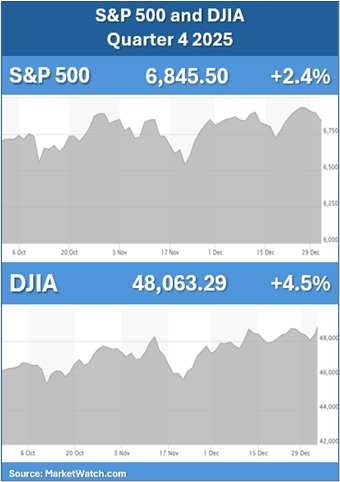
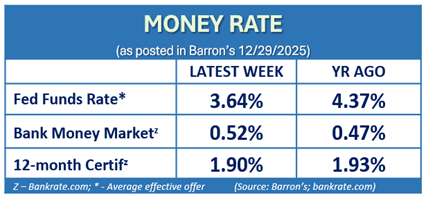
Overall, the data continues to support a watchful but constructive long-term outlook for equities. As always, investors need to carefully choose portfolios that represent their unique objectives. Our role as financial professionals is to closely monitor market developments and ensure your portfolio remains aligned with your time horizon, risk tolerance, and financial objectives. We remain committed to keeping you informed, proactive, and well-positioned to navigate evolving market conditions with confidence.
Inflation & Interest Rates
Key Points:
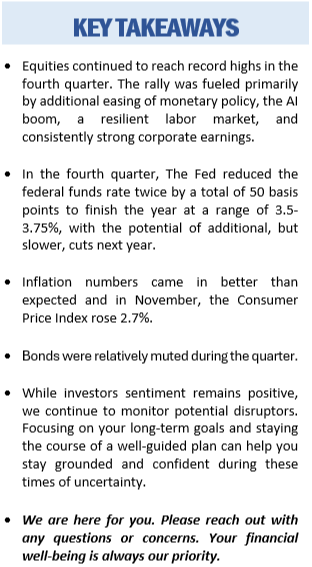
- Interest rates were lowered by 50 basis points in the fourth quarter, resting at 3.5 - 3.75%, after a total of three consecutive rate cuts since September. The Fed ended the year forecasting rate cuts in 2026, although at a slower pace than we experienced this quarter.
- The core CPI, which does not include food and energy prices, was cooler than anticipated, increasing 2.6% over 12 months.
The Federal Open Market Committee (FOMC) lowered interest rates in October for the second time in a row. The committee had to operate and make decisions based on data that was behind schedule or unavailable, due to the government shutdown that ended November 12. With the information available the FOMC voted to lower interest rates and the December rate cut represented the third in a row, bringing the rate range to 3.5 – 3.75%. Equity markets reacted positively to this news, with major indexes reaching record highs. Looking ahead, the Fed anticipates there could be additional rate cuts.(Source: finance.yahoo.com, 9/18/25)
The most recent Bureau of Labor Statistics data for consumer prices came from November, when the annual rate rose by 2.7%, lower than expected. The core Consumer Price Index (less food and energy) rose 2.6%. Economists polled by the Dow Jones were surprised by this result, as they had anticipated the CPI to rise to 3.1%. (Source: cnbc.com; 12/18/25)
The December 18 news release by the Bureau of Labor Statistics showed year-over-year, food showed a gain of 2.6% while energy increased 4.2%. Shelter costs increased 3.0%.
Movements in interest and inflation rates are critical for investors' financial planning and we will continue to closely monitor these key economic indicators.
The Bond Market &Treasury Yields
Key Points:
- The fourth quarter of 2025 was relatively calm for the U.S. bond market.
During the fourth quarter, the U.S. Treasury market demonstrated cautious behavior relative to equities. As the quarter ended, the 10-year Treasury yielded 4.18%, the short-term 2-year Treasury was 3.47% and the 30-year Treasury closed at 4.84%. (Source: treasury.gov resource center)
For investors, bonds can still play a meaningful role in diversification, providing relative stability during periods of equity volatility.
Investor’s Outlook
Key Points:
- Most strategists expect the bull market to extend into 2026.
- Market volatility is likely to persist, making discipline and perspective essential.
- Maintaining a long-term focus and avoiding short-term distractions has historically been one of the most reliable ways to achieve financial goals.
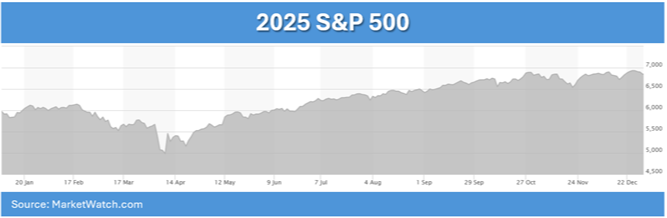
Experience imparts wisdom and broadens an investor’s perspectives. After the S&P 500 endured a drawdown of almost 20% in the first half of 2025, patient, non-emotional, well-disciplined investors were rewarded with new highs and robust returns in the second half of the year. We enter the new year with some lingering questions including, will 2026 be able to deliver another strong year of returns for the fourth consecutive year?
Analysts are optimistic about 2026, with a consensus that year-end returns will be positive, however, investors are aware that market pullbacks occur on average every year and a half, so statistically speaking, we must remain prepared for a potential pullback of 10% or more sometime in 2026. If 2025 taught us anything, it’s that during challenging times, it’s best to avoid emotional decisions. Although history is not a forecast of future outcomes, in 2025 the equity market rewarded investors who demonstrated patience and discipline during tough times.
As we begin 2026, there are numerous concerns that are reasons for investors to be cautious. While we are optimistic about the opportunity for another positive year in 2026, there are still many uncertainties to consider. The second half of the year will bring the appointment of a new Fed chairman. Dennis Dick, chief market strategist at Stock Trader Network, shares that, “The next Fed Chair is probably going to be much more dovish than Jerome Powell, so I would imagine that we actually see in the second half of this year that interest rates go down substantially.”
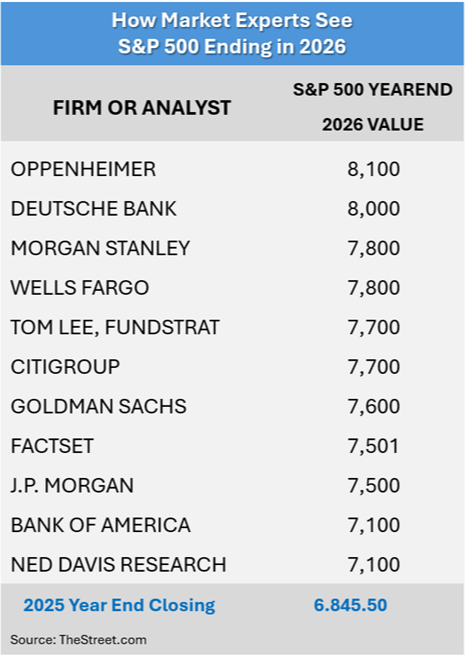
The continuation of tariff talks and the possibility of a struggling economy could also cause issues in the first half of 2026. High valuations mean that any earnings disappointments could also disrupt the recent upward trajectory of equity markets. Additionally, geopolitics in several regions are at a challenging point and could lead to more uncertainty, which always seems to disrupt equity markets.
2026 is a midterm election year and that historically has created increased uncertainty, as investors assess potential changes in Congressional control and their implications for taxes, spending, and regulation. While uncertainties remain, our focus continues to be on the factors most relevant to your personal financial situation. Many analysts still see the potential for the bull market to extend into 2026. Rather than viewing volatility solely as a risk, it can also be seen as a potential opportunity. Periods of market weakness can present openings to invest at more attractive prices, rebalance portfolios, or harvest losses to help offset capital gains. For now, we can appreciate the benefits of the current bull market while continuing to emphasize our guiding principle: proceed with caution.
A new year brings the opportunity to review your situation. Here are some proactive planning reminders:
- Evaluate your cash flow: Review your spending and savings plan to reflect goals and expected changes so you can maintain adequate cash flow.
- Portfolio rebalancing: We use periodic rebalancing as a strategy for helping keep your portfolio aligned with your risk tolerance, time horizon, and goals.
- IRA contributions for tax year 2025: Contributions can still be made until April 15, 2026.
- Notify us of any anticipated life changes: Such as retirement, estate planning changes, family changes, and significant age-based milestones.
Please be sure to check out our CFO Services and your Financial Life Calendar
Keep Your Complete Financial Future in View:
Don’t lose track of your financial goals. The most critical step is to have a strategy and plan. The next step is sticking to it.
Ensuring all the essential details of your financial life are attended to is an integral part of our role in our partnership to help you achieve your goals.
Our commitment is to exceed your expectations and deliver an exceptional experience while maintaining consistent and meaningful communication.
We value our partnership and are grateful for you and your trust in us! If we can do anything for you, please connect!
Help us help others! We want to help others like you!
Many of our best relationships come through introductions from our clients. We would be honored if you would add a name to our education list or invite someone to schedule an Introductory Meeting with us. Please reach out at info@terrabluewm.com if we can help!
*If you are kind enough to make an introduction, please disclose that you are a client and if you have any material conflicts resulting from your relationship with Terra Blue.