


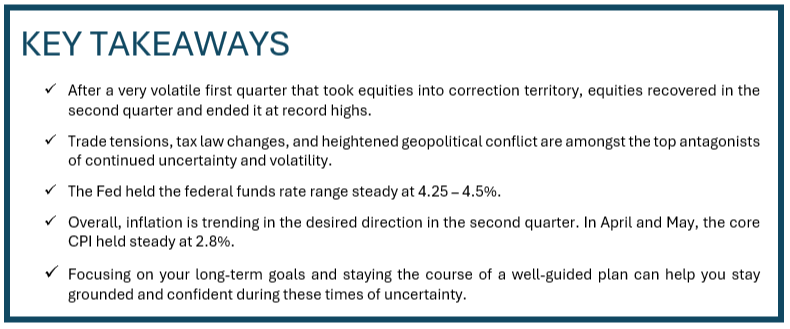
Almost every investor has heard the saying, “equities are for long-term investors.” This philosophy was reinforced in the first half of 2025, which witnessed significant and historical changes in equity movements. If you left Earth on January 1 and returned on June 30, you would see that the S&P 500 started the year on a high note and achieved a new high on June 30. This is great news for investors. However, the first half of this year has also been one of the most volatile ever, with the market experiencing a correction of nearly 20% before rebounding to reach a new high.
As the second quarter began, many analysts downgraded their annual forecasts, predicting potential doom and gloom for investors for the remainder of 2025. In early April, when people thought the world would collapse and the market dipped below 5,000, the outlook seemed bleak. Since then, the market has rallied and by early May entered positive territory for the year. After advances of approximately 5% in both May and June, the S&P 500 closed the second quarter at an all-time high, leaving investors who stayed with equities rewarded once again.
Several major factors continue to put pressure on equities. They included pending tariff policies, reluctant inflation rates, potential economic slowdown, and geopolitical conflicts.
Geopolitical conflicts took center stage at the end of the quarter. During late June, even tariffs took a side burner to geopolitical conflict in the news. However, the current tariff pause, as of the writing of this newsletter, is set to end in the next few weeks and talk of reciprocal tariffs is on the table for most countries. We remain committed to keeping a watchful eye on tariffs and their potential effects on our investment portfolios and financial plans.


Despite all these challenges, equities powered through to end the quarter. The S&P 500 closed the quarter at a record high of 6,203.31, up 10.57%, and posted its best quarter since December 2023. The S&P 500 was up 24.5% since a low hit on April 8 and is up 5.5% on the year as of June 30. The Dow Jones Industrial Average (DJIA) closed the quarter at 44,077.26, up 5%. For the year, the DJIA is up 3.6%. (Source: cnn.com; 6/30/25)
Investors still have not seen any interest rate cuts from the Fed in 2025, although, they are still projecting two rate cuts this year. For now, Federal Reserve Chair Jerome Powell noted they are, “well positioned to wait” before making any moves on rates. (cnbc.com; 6/18/ 2025)
In both April and May, the unemployment rate was a healthy 4.2%. In June the unemployment rate came in better than expected and fell to 4.1%.
2025 continues to be a year of change. While many signs are strong, others are cautionary. We are committed to keeping you aware of any changes that could directly affect your situation. Our goal is to consistently review your portfolios and to ensure they're aligned with your time horizon, risk tolerance, and goals.
INFLATION & INTEREST RATES
Key Points:
- Interest rates remained unchanged at 4.25 – 4.50% during the second quarter of 2025.
- The Fed is still forecasting rate cuts for 2025.
- U.S. inflation decreased in May to 2.4%, slowly inching closer toward the Fed’s 2% target.
In the Federal Reserve Press Release on June 18, 2025, the committee stated, “recent indicators suggest that economic activity has continued to expand at a solid pace. The unemployment rate remains low, and labor market conditions remain solid. Inflation remains somewhat elevated.” (Source: Federal Reserve Press Release; 6/18/25)
During the second quarter of 2025, the Federal Open Market Committee (FOMC) decided to maintain interest rates in the range of 4.25% to 4.50%. The Federal Reserve indicated that rate cuts are still possible this year, but Fed Chair Powell stated, “For the time being, we are well positioned to wait to learn more about the likely course of the economy before considering any adjustments to our policies,” during his post-June meeting news conference. (cnbc.com; 6/18/25)
In May, the Consumer Price Index (CPI) on a year-by-year basis was 2.4% and core inflation was 2.8%. Many anticipate that impending tariffs could reignite inflation in the coming months. We are watching how the economy is affected by tariffs, but for now, the economy has not seen any major changes due to tariffs.
Interest and inflation rate movements are integral for investors' financial planning, and we will continue to monitor these key economic indicators closely.
THE BOND MARKET AND TREASURY YIELDS
Key Points:
- Bonds, while typically used as a safe haven to volatility, were not exempt from volatility in the second quarter, and they remain sensitive to continued uncertainty.
- With the Fed still anticipating lowering interest rates this year, existing bonds may rise in value.
Bonds, while typically seen as a more secure option, were not exempt from volatility. Two days after “liberation day”, in April, the 10-year par yield curve rate fell to 4.01% and the 20-year dropped to 4.44%. By May 21st, the 10-year par yield curve rate rose to 4.58%, and the 20-year reached 5.08%. Yields then fell again as tension between the U.S. and Iran escalated. The 20-year note ended the quarter at 4.79% and the 10-year note ended at 4.24%.
Like many other things, the direction of bond yields remains unclear. Many factors affect them, including the movement of interest rates and inflation, geopolitical risk, and trade tensions. In particular, as it currently stands, the recently passed “One Big Beautiful Bill Act” could add over $3 trillion to the federal deficit over the next decade. The federal government issues bonds as a way to borrow money and finance the government’s operations. Hopefully, growth from tax cuts and higher tariffs could help counterbalance that debt.
We consider using bonds when they are appropriate for portfolios, and when we do we take into consideration a client’s risk tolerance, time horizon, and overall investment goals. Bonds can be an integral part of a well-diversified portfolio but please remember, while diversification in your portfolio can help you pursue your goals, it does not ensure a profit or guarantee against loss.
INVESTOR OUTLOOK
Key Points:
- While they had their share of volatility, stocks and bonds were positive for the quarter. Looking ahead, investors should know uncertainty could continue equity market volatility.
- Regardless of what the remainder or the year brings, proactive planning with a well-diversified portfolio that takes into consideration your risk tolerance and time horizon is still advised.
- A long-term investing strategy can be helpful during periods of short-term fluctuations and staying the course for your financial goals is typically the best path.
Right now, there is still a lot of uncertainty and that could extend market volatility. Lately, a sizeable number of the market’s gains have followed talks about the de-escalation of tariffs. Looming deadlines and lack of defined terms can keep economic uncertainty high not just for Americans, but globally. Other significant issues for equities, all of which we are monitoring, include:
- As of the quarter’s end, the economy has remained strong.
- Inflationary pressures and results could rise during the near future due to reciprocal tariffs.
- The Fed is still projecting to lower interest rates this year.
- The “One Big Beautiful Bill Act” was signed into law on July 4th.
- Global conflict remains. An escalation of the Israel-Iran conflict could affect oil prices. In addition, the Russia-Ukraine war continues.
Tariff and trade negotiations are expected to be revisited. These negotiations could create disruptions or positive surprises. The full impact on tariffs is yet to be seen for the American household and corporate earnings. “It takes some time for tariffs to work their way through the chain of distribution to the end consumer. A good example of that would be goods being sold at retailers today may have been imported several months ago before tariffs were imposed”, stated Fed Chair Jerome Powell. How much tariffs effect inflation is yet to be seen for U.S. consumers.
2025 continues to be a year of change for the U.S. On July 4th, the “One Big Beautiful Bill” Act was signed by the President. We will be addressing this bill and its impact in later communications. Volatility has ruled in 2025 and it could continue for a while. While staying aware of economic data and news is important, please keep in mind that minimizing your exposure to inflammatory media and speculative news reports can help reduce anxiety. Remember, although volatility has a negative connotation, it can also bring opportunity.
ON JULY 4TH, THE PRESIDENT SIGNED A NEW TAX BILL
This will change financial planning for millions of Americans. Here are four items within this bill that could impact you:
- Currently lower tax brackets will remain: The Tax Cuts and Jobs Act (TCJA) income tax brackets were to sunset at the end of this year. These brackets are now permanent, saving millions of taxpayers from a tax increase.
- Higher standard deductions become permanent: The higher standard deduction becomes permanent and will increase to $15,750 for single filers, $23,625 for head of households, and $31,500 for married individuals filing jointly. Also, there are new additional standard deductions for taxpayers over the age of 65 (subject to phaseouts).
- State and local deduction (SALT) are raised: From $10,000 to $40,000, with a 1% increase in the cap each year through 2029 before returning to the $10,000 limit for 2030. The deduction is reduced for higher-income taxpayers starts to phase out after $500,000 of income.
- The estate tax exemption: Increased from $13.99 million to $15 million for individuals and from $27.98 to $30 million for those married filing jointly.
Keep Your Complete Financial Future in View:
Don’t lose track of your financial goals. The most critical step is to have a strategy and plan. The next step is sticking to it.
Ensuring all the essential details of your financial life are attended to is an integral part of our role in our partnership to help you achieve your goals. We value our partnership and are grateful for your trust in us. If you have any questions or concerns, please reach out.
We want to help others like you! Many of our best relationships have come through introductions from our clients. We would be honored if you would add a name to our education list or invite someone to schedule an Introductory Meeting with us. Please reach out at info@terrabluewm.com if we can help!
*If you are kind enough to make an introduction, please disclose that you are a client and if you have any material conflicts resulting from your relationship with Terra Blue